
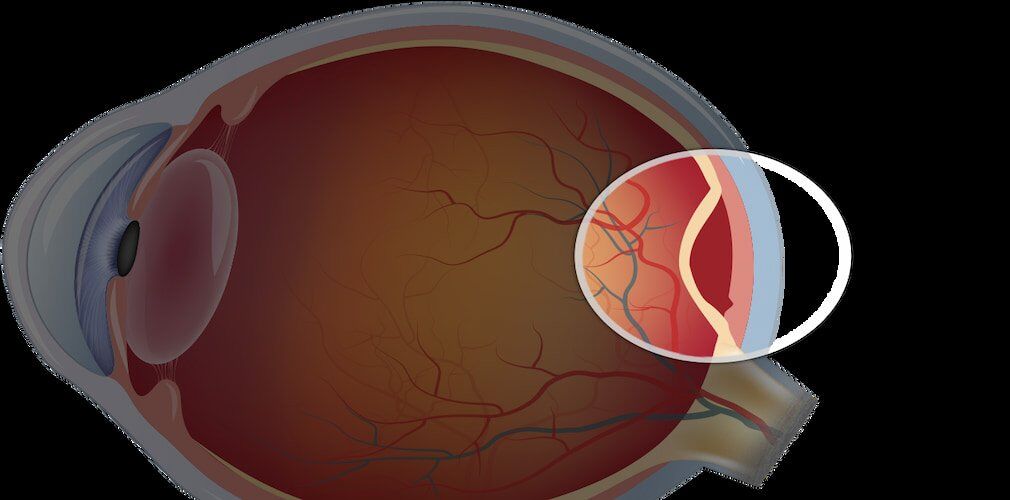
Retinal Tear or Detachment
The detachment of the retina is a separation of the retina by sub-retinal fluid from the ocular wall to which it is normally stuck (choroid). The detachment of the rhegmatogenous retina is the most frequent and occurs associated with a retinal tear, which allows the liquefied vitreous (the vitreous humor that has degenerated due to the passage of time) to pass to the sub-retinal space. There are also other less frequent types such as the detachment of the tractional retina and the detachment of the exudative retina.
For a retinal detachment to appear, two requirements are usually needed: the existence of a liquefied vitreous (degenerated) and a retinal tear.
Symptoms
The main symptoms that may indicate the presence of retinal detachment are:
- Luminous flashes and flying flies: In 60% of cases, premonitory symptoms may appear, such as light flashes (photopsies) and flying flies (myodesopsias).
- Defect in the visual field: After a period of time a visual field defect appears, the patient usually describes it as a black curtain.
- Loss of central vision: It appears when the macula is affected.
Therefore, retinal detachment only occurs with visual symptoms, without pain or discomfort.
The detachment of the retina is diagnosed by checking the fundus after dilatation of the pupil, usually using an instrument called an ophthalmoscope.
Treatment Therefore, at first, if the retina is only torn and the detachment has not yet occurred, the ophthalmologist can opt for a preventive treatment by applying a laser in the office (photocoagulation) or a cold treatment (cryotherapy). Once the retina has detached, the only possible treatment is the application of some surgical techniques.
The surgery of the detachment of the retina must be as early as possible to improve the success rate and the final visual result. The patient will be recommended postural rest in order to avoid or minimize the progression of detachment, facilitating the surgical act. The main objective will be to close the retinal tears.
At Harley Street Hospital, we have the best doctors to diagnose and treat retinal tear or detachment. Book an appointment to get a specialist´s opinion.
Frequently Asked Questions
How do you know if you have a retinal tear or detachment?
Symptoms of a retinal tear or detachment may include sudden onset of floaters, flashes of light, or a shadow or curtain-like obstruction in your peripheral vision. Prompt evaluation by an eye care professional is crucial if you experience any of these symptoms.
Can a retinal tear heal on its own?
Retinal tears typically do not heal on their own and may require medical intervention to prevent further complications such as retinal detachment.
What is the difference between a tear and a detachment?
A tear is a partial separation of the retina from the back of the eye, whereas a detachment is a complete separation, both requiring prompt medical attention to prevent vision loss.