Day Surgery TLIF Lumbar Fusion
Lumbar fusion or arthrodesis is a technique that has been used for decades to solve instability problems in that region.
Since its inception, arthrodesis techniques have been modified for various purposes: to improve rigidity, to allow better correction of vertebral angulations, to increase the fusion rate, to be able to dispense with external braces, to decrease damage to healthy tissues, to reduce intervention time and bleeding, etc. But not all improvements can always be achieved at the same time, which is why several of the arthrodesis techniques are still in force, constituting a range of options for each case that arises.
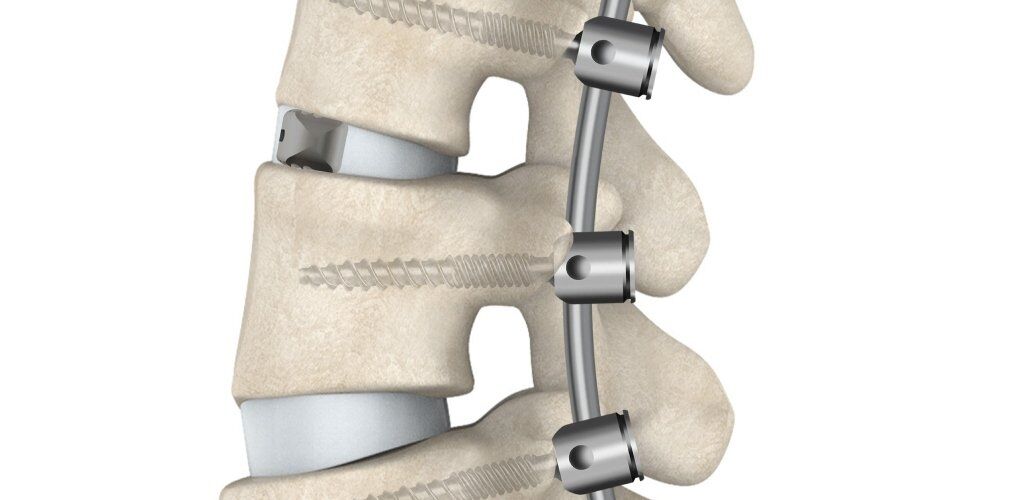
TLIF technique The TLIF arthrodesis, an acronym for “Transforaminal Intersomatic Lumbar Fusion” is a technique that allows both the anterior and the posterior part of the vertebral segment to be fused, but accessing only from one side of the vertebral posterior part. Therefore, it improves the fusion rates and the degree of correction in the same measure as the double accesses (anterior-posterior), but it simplifies the task and the risks when using a single approach and a single side.
Тhe procedure Access to the disc (anterior part) is made through the neural foramen, that is, the hole through which each lumbar root comes out. But since the size of the foramina is insufficient to introduce implants, the technique requires removing the articular assembly (facets) and associating a fixation with pedicle screws. One of the disadvantages of TLIF is that manipulation of the neural ganglion in the foramen, especially when inserting the implant, can cause postoperative (usually transient) sciatica or long-term residual sensory discomfort. Postoperative sciatica is especially common after large corrections in height and disc displacement (spondylolisthesis). This problem gradually disappears in 5-7 weeks.
The advantages of TLIF Because it is a foramen access technique, which allows a high degree of correction and ensures the success of the fusion, it is especially useful when it is necessary to reach the foramen (foraminal stenosis), when there are degenerative deformities (scoliosis and degenerative spondylolisthesis), or when the posterior fusion alone does not guarantee stability (isthmic spondylolisthesis). Due to its tendency to cause root discomfort in the postoperative period, it should perhaps be avoided in cases of pure lumbar involvement without canal involvement, thus avoiding any unnecessary neural manipulation.