Macular Hole, Epiretinal Membrane & Vitreomacular Traction (VMT)


Macular Hole, Epiretinal Membrane & Vitreomacular Traction (VMT)

A

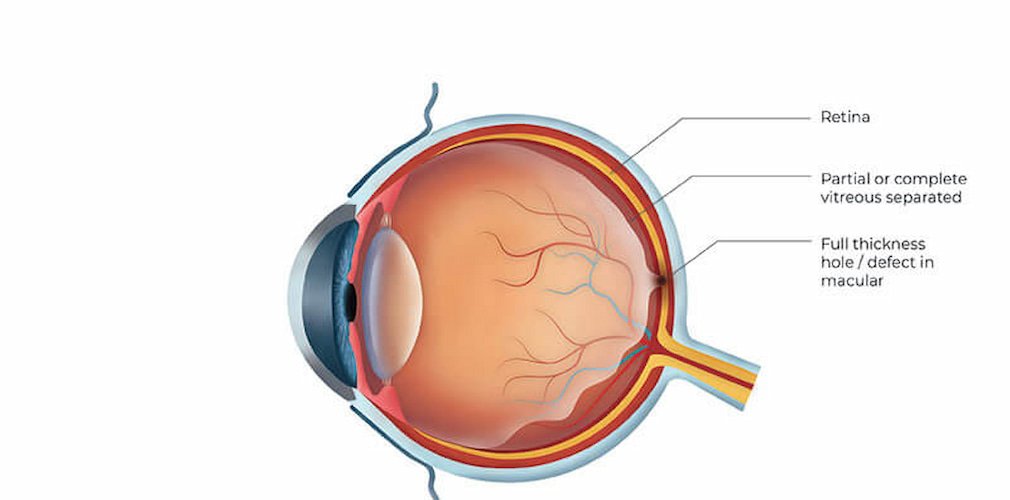
 macular hole refers to breakage due to the traction of the center of the retina (macula). The vitreous attached to the retina tractions and in some cases can generate a defect of full thickness, ie a hole in the macula. It is more common in women (3: 1) and can be bilateral (both eyes can be affected) in 15% of cases.

Symptomatology
The clinical manifestations depend on their degree since it is classified in 4 grades. In the beginning, there are no symptoms and, in the last degree (grade 4), there is a significant loss of central vision. If the patient looks at a vertical line of light, he will see that the center is missing.

Exploration
The ophthalmologist when reviewing the fundus will see the macular hole. For its study, OCT (Optical Coherence Tomography) is used as the main method, which will allow establishing the degree of evolution of the patient.

Treatment
The treatment of the macular hole is always surgical. A vitrectomy should be performed with removal of the innermost layer of the retina, called the internal limiting membrane. During the postoperative period, the patient must remain upside down for a few days as gas is placed inside the eye and this position will help to close the hole.

Recently a drug has appeared to inject into the vitreous cavity, which in small cases can release the vitreous traction and close the hole without the need for surgery.

Frequently Asked Questions

Epiretinal membrane with vitreomacular traction is a condition where a thin layer of scar tissue forms on the macula, the central part of the retina, causing distorted or blurred vision. It occurs when the vitreous gel in the eye pulls away from the retina but leaves behind scar tissue that can distort the macula, leading to vision problems.

A macular hole is a small break in the macula, causing central vision loss, while an epiretinal membrane is a thin layer of scar tissue that forms on the macula, leading to distorted or blurred vision. Both conditions affect the macula but present different structural abnormalities and visual symptoms.

VMT, or vitreomacular traction, is a condition where the vitreous gel in the eye remains partially attached to the macula, causing traction and distortion of the central vision.


Age-Related Macular Degeneration (AMD)

Age-Related Macular Degeneration (AMD)

A

ge-related macular degeneration (AMD) is an ocular degenerative disease that causes significant visual disturbances by affecting the center of the retina, the macula, and therefore, the center of our visual field and the vision of the details, both near and far.

AMD is a chronic disease of multifactorial origin (it can be caused by multiple causes and some of them at the same time) and, as in many chronic diseases that affect adults, in AMD there are a number of genetic factors, which influence the development of this ocular disease.
Doctors suspect AMD in those patients who suffer:

  • A deformed vision of objects: For example, door and window frames may look curved instead of straight.
  • Black spots in the central field of vision (scotomas) that, for example, hinder the recognition of people, since the macula has been affected.
  • Any sudden loss of central vision.

Clinical classification of age-related macular degeneration has been proposed in which small “drusen” (yellow deposits under the retina) are considered normal changes in retinal aging. These cases do not have a significant increase in the risk of developing late forms of AMD. In contrast, in the early form of the disease, patients have medium-sized drusens. In the intermediate AMD, they have large-sized drusens. Late forms of AMD include neovascular, wet or exudative and/or geographic atrophy.

Its prevalence is especially high after 65 years of age, but after the ’50s, serious cases of the disease can still be detected. As the age increases the number of retinal lesions as well as their severity and bilaterality, being especially significant after 85 years.

Although the only universally accepted factor is age, other possible risk factors have been implicated in multiple studies. Tobacco has been linked to AMD through the alteration of the choroidal circulation.

Treatment

At present, there is no treatment for the dry form of the disease. According to the results of the studies, patients who can benefit from it receive supplements with antioxidants.

In the wet form, the treatment of choice is the intravitreal injection of antiangiogenic drugs with a variable periodicity and frequency. In general, all of them start with a monthly injection on three consecutive occasions and then a different pattern according to the obtained response and the chosen drug. Intravitreal injection is performed on an outpatient basis, under topical anesthesia and meeting the established criteria has a very low number of complications.

In general terms, antiangiogenic treatment manages to stop the loss of vision in 90% of situations, of which 40% can even obtain improvements in visual acuity, according to the results of studies with these drugs.

In some cases, we can use direct photocoagulation with a laser when there is sufficient distance to the center of the fovea to treat the choroidal membrane and in cases of the peripapillary choroidal membrane, we can choose the surgical treatment to extract this complex.

Frequently Asked Questions

Age-related macular degeneration (AMD) typically occurs in individuals over the age of 50, becoming more prevalent with advancing age. However, it can also affect younger individuals, particularly those with a family history or specific risk factors.

Age-related macular degeneration (AMD) has two main stages: early AMD, characterized by small drusen deposits in the macula, and late AMD, which is further divided into dry AMD (geographic atrophy) and wet AMD (neovascular AMD) where abnormal blood vessels grow beneath the retina.

The risk for age-related macular degeneration (AMD) increases significantly after the age of 50, with prevalence rising with advancing age. However, certain genetic and lifestyle factors can influence the risk of developing AMD at a younger age.

Varicocele Treatment

Varicocele Treatment

V

aricocele is an anatomoclinical syndrome characterized by dilation of the venous plexus and clinically by spermatic venous reflux into the veins of the pampiniform plexus that drain the blood from the testicles. The presence of these testicular varices has been related to male infertility, more specifically, with a decrease in the number of spermatozoa, their mobility, morphology, and capacity for fertilization.

Treatment
The aim of varicocele correction is to improve the reproductive capacity of the patient, improve the production of androgens and in cases of testicular pain, its suppression.
In the cases of men with infertility and varicocele surgery is not always necessary.
Assisted Reproduction Techniques such as ICSI, intrauterine insemination can be the way to achieve a pregnancy. But in most cases, the correction allows a greater chance of getting this.

The treatment for varicocele can be surgical or by embolization. To decide
what kind of access is going to be carried out, it is necessary to keep in mind the three types of varicocele formation pathways: failure of the internal spermatic vein, hyperpressure of the primitive iliac vein and anomalies of the venous plexuses.
Regarding the embolization of the testicular veins, it can be of two forms: antegrade by scrotal via or retrograde via the femoral vein. Other forms of intervention are sclerotherapy and surgery for laparoscopy, which has a high cost, and the microscopic, which is the lowest rate of recurrence presents.

The prognostic factors in the adult are related to the age of the couple and their fertility status, the presence of other associated pathologies such as infections, obesity, toxic consumption, etc., the time of infertility, the degree of spermogram and the levels of FSH, LH and androgens.
Among the most important beneficial changes of the varicocele correction is the recovery of testicular volume, which occurs in 70-80% of adolescents in which the testicular size was inferior to normal. It has also been found an increase in testosterone concentration and in the quality of the semen when they are compared with the non-operated patients.

Erectile Dysfunction


Erectile Dysfunction

E

rectile dysfunction can be described as a total inability to achieve an erection, an intermittent disability or a tendency to maintain only brief erections.

Patterns of erectile dysfunction
In older men, erectile dysfunction usually has a physical cause, such as illness, injury or side effect of other drugs. Any disorder that causes nerve damage or impairs blood flow in the penis has the potential to cause erectile dysfunction. The incidence increases with age. Approximately 5% of men who are 40 years old and between 15 and 25% of men who are 60 years old experience erectile dysfunction. However, it is not an inevitable consequence of aging.

Erectile dysfunction is treatable at any age and the knowledge of this fact has been increasing. Many more men have sought medical help and have returned to having normal sexual activity thanks to the greater effectiveness of treatments against erectile dysfunction. Urologists are responsible for addressing the problem, generally.

Although erectile dysfunction is more common in men older than 65 years, as noted, this disorder can occur at any age. It is very important to emphasize that an occasional episode of erectile dysfunction is something perfectly normal that happens to most men. In fact, most of the cases should not be cause for concern. With increasing age, it is also normal to experience changes in erectile function. Erections may take longer to develop, not be as firm or require a more direct stimulation to occur. Men also notice that their orgasms are less intense, the volume of the ejaculate is smaller and the recovery time increases between erections.

When erectile dysfunction proves to have a pattern or becomes a persistent problem, it can deteriorate a man’s self-image and affect his sex life. It can also be a sign of an emotional or physical problem that requires treatment.

Treatments include;

  • weight loss and increased exercise (this may reduced the risk of erectile dysfunction by up to 70%)
  • treatment of any hormone abnormality (testosterone treatment is only indicated if your testosterone levels are low and may be harmful if your the levels are normal);
  • lifestyle modification (e.g. reduce stress, stop smoking, reduce alcohol consumption & stop illicit drugs);
  • treatment of any anatomical abnormality if present (e.g. circumcision, frenuloplasty, penile straightening);
  • psychological support if necessary.

First line treatment will be medication with a phosphodiesterase inhibitor such as sildenafil (Viagra), tadalafil (Cialis), vardenafil (Levitra) or avanafil (Spedra). These drugs only work when used together with sexual stimulation and will have no effect on your sex drive. There is no evidence that these drugs are dangerous if you have underlying heart disease. However, they should not be used if you are taking nitrates (e.g. GTN, isosorbide) for angina

Other second Line Treatments

  • Penile injections to produce erections
  • Medicated urethral system for erection (MUSE)
  • Vacuum erection assistance devices (VEDs)
  • Vascular surgery/angioplasty
  • Penile prostheses

Chronic Prostatitis

Chronic Testicular Pain

P

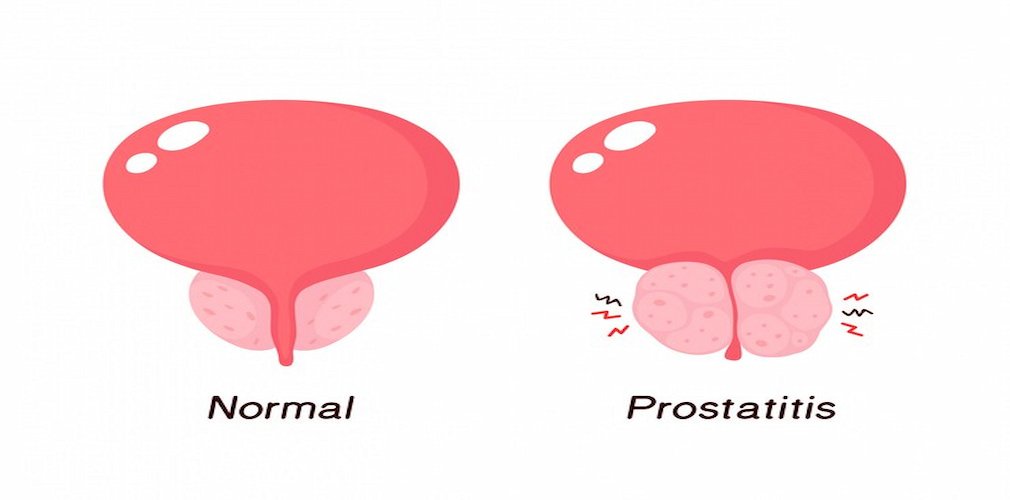
rostatitis is the most common parenchymal urinary infection in men between the second and fourth decades of life.
The term prostatitis comprises a broad spectrum of nonspecific symptoms of the lower genitourinary tract.

Chronic prostatitis has multiple hypotheses regarding its origin, it is believed that they can happen due to an obstruction, intraductal reflux, infectious causes such as consequence of prostatic anatomy.

In the case of chronic prostatitis syndromes, we find that sometimes the symptoms are scarce or nonexistent and only involve alterations in the semen that condition infertility.

On other occasions, sexual manifestations predominate, such as total or partial loss of erection, painful ejaculation, premature ejaculation or haemospermia (presence of blood in semen).

But the most common is the existence of pelvic pain and urinary symptoms. The pain is referred to different areas: suprapubic, perineal, lumbosacral, scrotal, penile, inner side of the thighs. The most frequent urinary disorders are obstructive (onset of voiding difficulty, decreased caliber, post-void residual urine and even acute urinary retention) or irritative (imperiousness, passing frequent of small amounts of urine, painful urination or tenesmus). Finally, in case of chronic prostatitis the symptoms last for at least 3 months and, given the similarity with the clinical and pathological process of benign prostatic hyperplasia, it is sometimes difficult to distinguish between these two entities.

Medical treatment
In summary, in addition to the use of antimicrobials, and although obstruction of the bladder neck is an infrequent complication of the prostatitis syndrome, drugs that produce an opening of the urethrovesical exit region may help to alleviate both the obstructive and irritative symptoms of these patients. and to improve the deteriorated quality of life that they present.